

The team that doesn’t exist
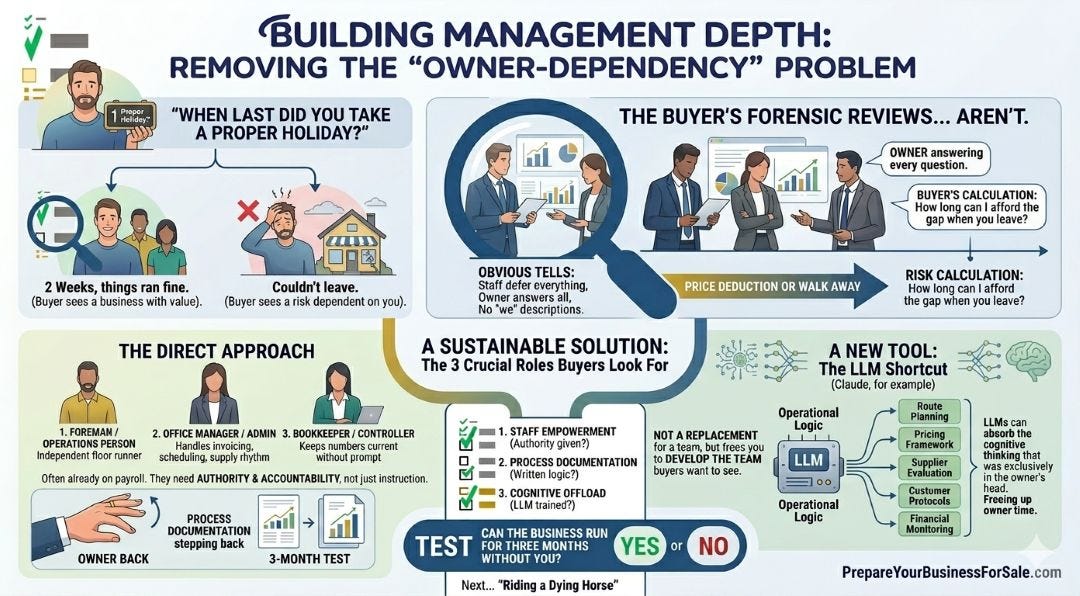
There is a question I ask every seller early in the process. It sounds casual. It is not. “When last did you take a proper holiday?” Remembering what a holiday is, is a start, but not a good one.

The answer tells me almost everything I need to know about the business's management depth. If the owner took two weeks off last year and came back to find things running, the business has something underneath it. If the owner hasn’t taken more than a long weekend in five or six years because “the place falls apart when I’m not there,” we have a problem. Not a staffing problem. A structural one.
Not all buyers want to buy a job
A buyer will ask the same question, phrased differently. He will ask to meet the management team. He will want to know who runs operations when the owner is away.
Who makes decisions about pricing, hiring, purchasing, and scheduling? And if every answer comes from the owner with “me,” the buyer is no longer looking at a business. He is looking at a dependency that he will inherit the moment the sale goes through. That business is a job.
I have seen this more times than I can count, across every kind of business. A printing company where the owner was the estimator, the production scheduler, and the quality controller. A construction subcontractor where the foreman reported directly to the owner because there was nobody between them. A food distributor where the owner’s wife did the books, the owner did the selling, and the warehouse manager did everything else.
In each case, the business was profitable, and the owner was exhausted. He was working sixty-hour weeks and had been for years, not because the business demanded it, but because the business had never been structured to work any other way.
So easy to spot
The buyer sees this shortfall in the first meeting. He does not need a forensic review to spot it. The tells are obvious: the owner answers every question himself, and the staff defer to him on everything. Nobody in the room can describe the business without looking at him for confirmation.
The buyer’s internal calculation begins immediately. If I buy this business, how long before the owner can walk away? Six months? A year? Longer? And what happens in the gap between the owner leaving and someone else being competent enough to replace him? Every month in that gap is a month of risk, and the buyer will either price it into the offer or walk away entirely.
The solution sounds expensive. It is not. When small business owners hear “management team,” they picture a boardroom and six salaries they cannot afford. That is not what a buyer is looking for. A buyer wants to see three things.
A foreman or operations person who can run the floor without instructions.
An office manager or administrator who handles the daily rhythm of invoicing, scheduling, and supplier payments.
A bookkeeper or financial controller who keeps the numbers current without the owner having to ask.
Three people, in many cases already on the payroll, who have simply never been given the authority or the accountability to do what they are capable of doing. The problem is almost never that the staff are not good enough. It is because the owner has never empowered them. He checks their work. He overrides their decisions.
Over time, the staff learn that initiative is not rewarded. They stop offering it. The owner interprets this as confirmation that they cannot manage without him. It is a self-fulfilling cycle, and it takes a deliberate effort to break it.
Put the effort in
That effort looks like this. Pick one function the owner currently handles personally. Hand it to the best person available. Write down how the owner makes the decisions in that function, using the process documentation approach from my previous article:

Let the staff member run it for three months without interference. Review the results. If it worked, move to the next function. If it didn’t, diagnose why and try again. This is not a reorganisation. It is a slow, deliberate transfer of operational authority from one person to several, tested and refined over time.
The motive doesn’t matter. The result does.
The businesses I have seen sell well are almost always the ones where the owner started this process years before the sale. He didn’t do it because he was planning to sell. He did it because he was tired, or because his wife told him to, or because he had a health scare and realised that the business would collapse if he were incapacitated for three months.
By the time a buyer arrived, the owner could demonstrate that the business had operated without him for extended periods, and the buyer could see the evidence in the financials, the staff, and the operating rhythm.
But what if an owner is sitting in this position today, years behind where he needs to be, without the budget to hire the three people described above?
The machines are here!
Something has changed recently that may be worth watching. Large language models... LLMs, or “AI”, the current buzzword… have become capable enough to absorb a significant amount of the operational thinking that used to live exclusively in the owner’s head. Route planning logic, pricing frameworks, supplier evaluation criteria, customer communication protocols, even financial monitoring... these are all things that an LLM can be trained to assist with, if the owner is willing to invest the time in setting it up properly.1
I am not suggesting that a piece of software replaces a management team. It does not. A buyer still wants to see people who can make decisions. But an owner who has been doing everything himself for twenty years, and who cannot afford to hire three new staff members overnight, may find that an LLM takes enough of the cognitive load off his desk to free him up to do the one thing that actually matters: developing the people he already has into the team the buyer wants to see.
We are yet to see whether LLM Agents appeal to the kind of owner who has been running things his own way for decades. The technology is there. The question is whether the temperament is. A man who has never delegated to a human being may not find it any easier to delegate to a machine. But for the owner who is willing to try, it is an option that did not exist two years ago, and it may change the arithmetic of preparation for businesses that would otherwise run out of time.
This is new territory. I mention it because ignoring it would be dishonest. The traditional advice... hire a foreman, train an office manager, develop a bookkeeper... remains the right answer. But the path to getting there may have a new shortcut, and any owner thinking about selling in the next five years should at least be aware it exists.
The test has not changed. Can the business run for three months without you? If the answer is no, the reason does not matter. What matters is that you start fixing it now, with whatever tools are available to you.
Next... Riding a Dying Horse: When the industry is moving on, the owner is the last one to notice, and the best time to sell was last year.
Everybody’s talking about how AI is going to take away so many jobs. Nobody’s mentioning the inertia to be overcome by small business owners to get themselves up and running, and competent in using our new overlords to do a bunch of work for their employees. When do we see the rise of the LLM/AI Consultant and Trainer?